


If you haven’t been paying attention to switches for a couple of years, it’s easy to think the market is still just “another JWK recolor” vs “another long-pole linear.” But in the last ~1–3 years, the switch landscape has had a very specific kind of evolution: less hype around novelty stems and more engineering aimed at repeatability, reduced variance, and “good out-of-the-bag” feel.
The headline is Hall-effect (magnetic) switches going mainstream, but the more interesting story is how switch makers tightened the whole stack: lubrication, tolerances, housing geometry, springs, and even light management. The result is that the typical 2025/2026 switch – whether it’s a traditional MX-contact design or an HE switch – is far more likely to feel intentional without requiring the user to lube, film, and pray.
1) Hall-effect switches stopped being “gaming weird” and started being… a switch
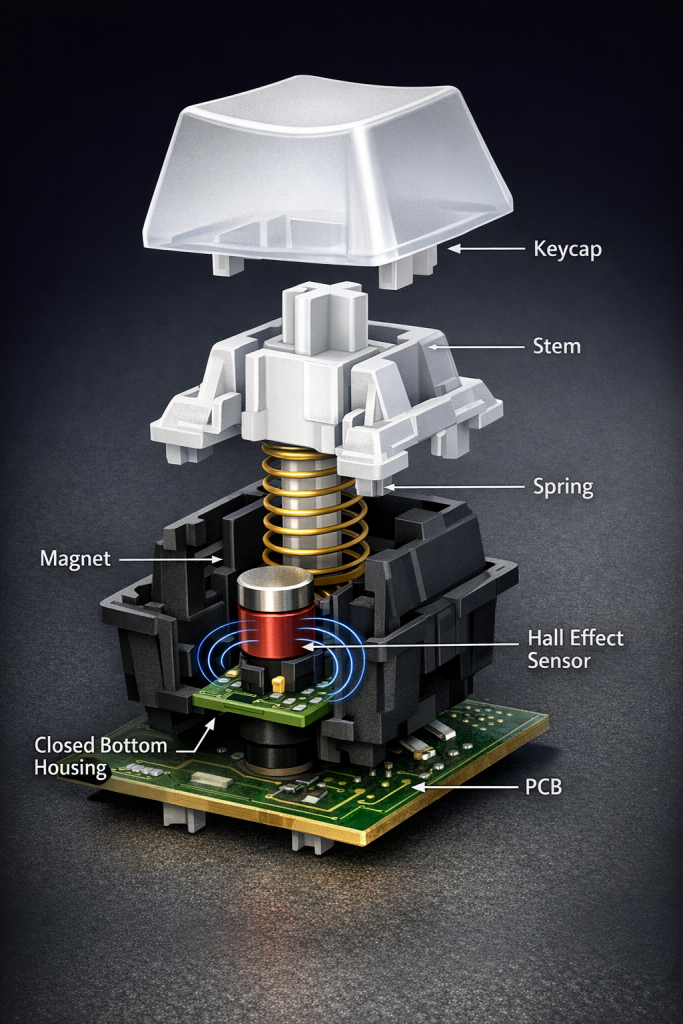
Magnetic (Hall-effect) boards existed before, but the modern wave turned HE into a platform: continuous travel sensing enables features like adjustable actuation and “rapid trigger,” and that kicked off a land rush. Even mainstream tech press now treats HE as a category that every big keyboard brand is expected to have.
The early criticism of HE switches was pretty consistent: wobble, inconsistent sound, and that “hollow plastic instrument” vibe compared to a tuned MX build. What’s changed recently isn’t just firmware – it’s switch mechanics catching up:
Closed-bottom and redesigned housings: One of the most practical refinements is housing geometry aimed at stability and acoustics. Wooting’s own docs for the Lekker L45 V2 explicitly call out tighter tolerances, redesigned housing/stem stabilization, and more lubrication as “key improvements.” And in broader coverage of newer Wooting boards/switches, you see the same themes repeated: reduced wobble and improved sound, paired with closed-bottom designs (which generally help sound consistency by controlling resonance paths and bottom-out behavior).
Springs got longer (on purpose): A long spring trend has existed in MX linears for a while, but HE makers are now leaning on spring choice to improve return behavior and perceived smoothness. Review coverage of newer HE switch variants points to longer springs and tighter tolerances as contributors to stability and premium feel.
Pre-lube became normal for HE: A lot of HE switch product pages now present “pre-lubed” as table-stakes, not a boutique perk. Gateron’s Magnetic Jade HE, for example, is marketed as pre-lubed and designed for Hall-effect boards, with travel/force specs clearly framed around adjustable pre-travel.
Now, here’s the important mechanical nuance: with HE switches, actuation is a sensing problem, not a leaf-contact problem. That shifts the manufacturing priorities. You’re no longer chasing leaf click consistency; you’re chasing stable travel, minimal lateral play (because wobble affects feel and perceived sound), and predictable magnetic field behavior across the stroke. It’s telling that Gateron’s Magnetic Jade HE specs include initial and bottom-out magnetic flux values – this is basically the analog equivalent of publishing a force curve “shape” for the sensor domain.
Is every HE switch suddenly perfect? No. But the last couple of years are where you can clearly see the industry working through the “HE doesn’t have to feel like a toy” phase by attacking wobble + sound + lubrication at the switch level, not just with foam stacks and marketing.
2) Cherry MX2A is the “legacy retooling” moment – and it matters more than it sounds
Cherry’s MX2A announcement in 2023 reads like a simple refresh – “smoother, better acoustics, 100M+ actuations” – but culturally it’s a pivot: Cherry essentially acknowledged that enthusiast expectations shifted toward factory finish quality, not just brand lineage.
The key technical point is factory lubrication and mechanical refinement as a first-class product feature. Cherry and coverage of MX2A talk about improved smoothness and acoustics via redesigned elements and better factory lube. Reviewers also call out visible factory lubrication and its effect on scratch and sound, even if it doesn’t magically eliminate all Cherry scratch.
Why MX2A matters beyond Cherry fandom: it’s a signal that manufacturing quality and consistency became competitive features in the mainstream switch market. The last decade trained enthusiasts to treat lubing/filming as normal. The last 1–3 years pushed that expectation upstream: switches increasingly ship closer to the “post-mod” baseline. MX2A is basically Cherry admitting that the market now grades you on out-of-box feel.
Also: MX2A is interesting precisely because it’s not a radical reinvention. It’s iterative engineering and process tuning – tooling, lube application, spring/stem refinements – applied to the most standardized switch geometry on the planet. That’s the kind of advancement that changes what “default switch quality” means for everyone.
3) Clickies weren’t left behind: Kailh BOX V2 shows how “small” mechanical changes add up
Clickies are mechanically harder to make feel refined because you’re stacking moving parts and energy release mechanisms. The Kailh BOX V2 updates are a good example of recent “engineering housekeeping” that enthusiasts actually feel.
Kailh’s own write-up contrasts BOX V1 and V2 with changes to housing (including LED slot design and color/material choices) and a move to a longer 19 mm gold-plated spring for more resilience. Product pages emphasize structure optimization, POM stem usage, and 5-pin positioning.
This isn’t just cosmetic. Changes like spring length and housing tolerances affect:
- Return dynamics (how “snappy” the upstroke feels, and whether the click mechanism resets cleanly)
- Acoustic repeatability (how consistent each key sounds across a board)
- LED diffusion and compatibility (less about aesthetics, more about standardized builds without weird interference)
The interesting meta-trend here is the same as with linears: manufacturers are spending effort on repeatable geometry and predictable behavior, not just novelty.
4) The quiet revolution: lubrication and tolerance control became the new “innovation”
If you want one boring-but-true explanation for switch advances lately, it’s this: process control is the product now.
Factory lubrication used to be something you avoided (“mystery lube, inconsistent, gritty after a month”). In the last few years, switch makers – both legacy and enthusiast-facing – have normalized pre-lube and improved how it’s applied. Cherry publicly frames MX2A’s feel and acoustics improvements around that kind of refinement. And HE switch makers describe lubrication and tighter tolerances as core improvements, not footnotes.
You can see the philosophy shift in how specs and marketing are written:
- “Pre-lubed: Yes” is printed like a basic capability on HE switch listings.
- “Enhanced stability / tighter tolerances” is listed as a primary feature, not a vague promise.
This is not as exciting as a new tactile mechanism, but it’s the thing that changes the average experience. When tolerance stacks improve, the entire ecosystem benefits: less stem wobble, fewer random scratchy batches, and less need for films just to fix manufacturing variance.
5) Where this is going next (and what to watch as a switch nerd)
Based on the direction of the last 1–3 years, a few trajectories look obvious:
HE switches will keep converging on “MX sound and feel,” mechanically. The sensing part is largely solved; the differentiator is now stability, housing acoustics, and long-term consistency. The newer Wooting and Gateron narratives are already centered on wobble + sound + refinement.
MX-contact switches will keep raising their “default finish” baseline. MX2A is the clearest example from a legacy manufacturer, but it reflects a broader expectation that stock switches should be smooth enough that lubing is optional, not mandatory.
Specs will get more honest (or at least more complete). HE listings already publish flux numbers; I’d expect more manufacturers to publish more measurable details as the market matures – less “thocky” and more “here’s what we changed in the geometry and why.”
Closing thoughts: refinement is the real innovation
The mechanical keyboard world didn’t get a single revolutionary new switch mechanism in the last three years. What it got instead is arguably more important: convergence toward precision.
Hall-effect switches are no longer gimmicks; they’re mechanically credible. Traditional MX switches are no longer assumed to be scratchy until proven otherwise. Clickies are being refined rather than merely reissued.
The innovation cycle has shifted from invention to optimization. And for anyone who cares about feel curves, return force dynamics, acoustic signatures, and long-term consistency, that’s a very good thing.
We are entering the era where “stock” no longer means “unfinished.”
Me? I am still way too old-school to HE switches and prefer my MX clears and Black Vintage switches over anything else.
